AssemblyAI has launched STT-3.7, a new speech-to-text model replacing the Universal family. It offers increased language coverage and significant improvements to speaker identification accuracy.
AssemblyAI has released an update to its Medical Mode feature designed to improve the transcription of high-stakes clinical terms like medications and diagnoses. The update specifically reduces drug name miss rates by 30% in English and up to 62% in Spanish, while maintaining existing word error rates.
Google has expanded its AI Edge Gallery with new on-device speech capabilities, enabling offline, low-latency transcription and synthesis. Developers can now integrate these high-performance models via Android's ML Kit or cross-platform MediaPipe Tasks, supporting over 100 languages with significant energy efficiency.
AssemblyAI has introduced SpeakerRevision, a feature that delivers a corrected set of speaker labels at the end of a live stream. By utilizing future context unavailable during real-time processing, it achieves accuracy levels comparable to asynchronous transcription, reducing the need for duplicate processing pipelines.
Gradium has released Phonon, a suite of compact (65-75 MB) text-to-speech models designed to run entirely on edge devices. It supports five languages, operates offline, and performs competitively against models significantly larger in size.
Cartesia has introduced two models for voice applications: Sonic (text-to-speech) and Ink (speech-to-text). Built on State Space Model (SSM) architecture, these models are designed for ultra-low-latency, real-time performance suitable for production voice agents.
AssemblyAI has introduced Universal-3 Pro, a specialized speech-to-text model that allows developers to provide instructions directly to the transcription process. It supports verbatim and clean transcription, custom audio event tagging, and handles code-switching between six languages.
AssemblyAI has released AssemblyAI-TTS-1, a text-to-speech model built for voice agents. It features sub-100ms latency, 4,000+ available voices, and instant voice cloning, priced at $15 per 1M characters without concurrency limits.
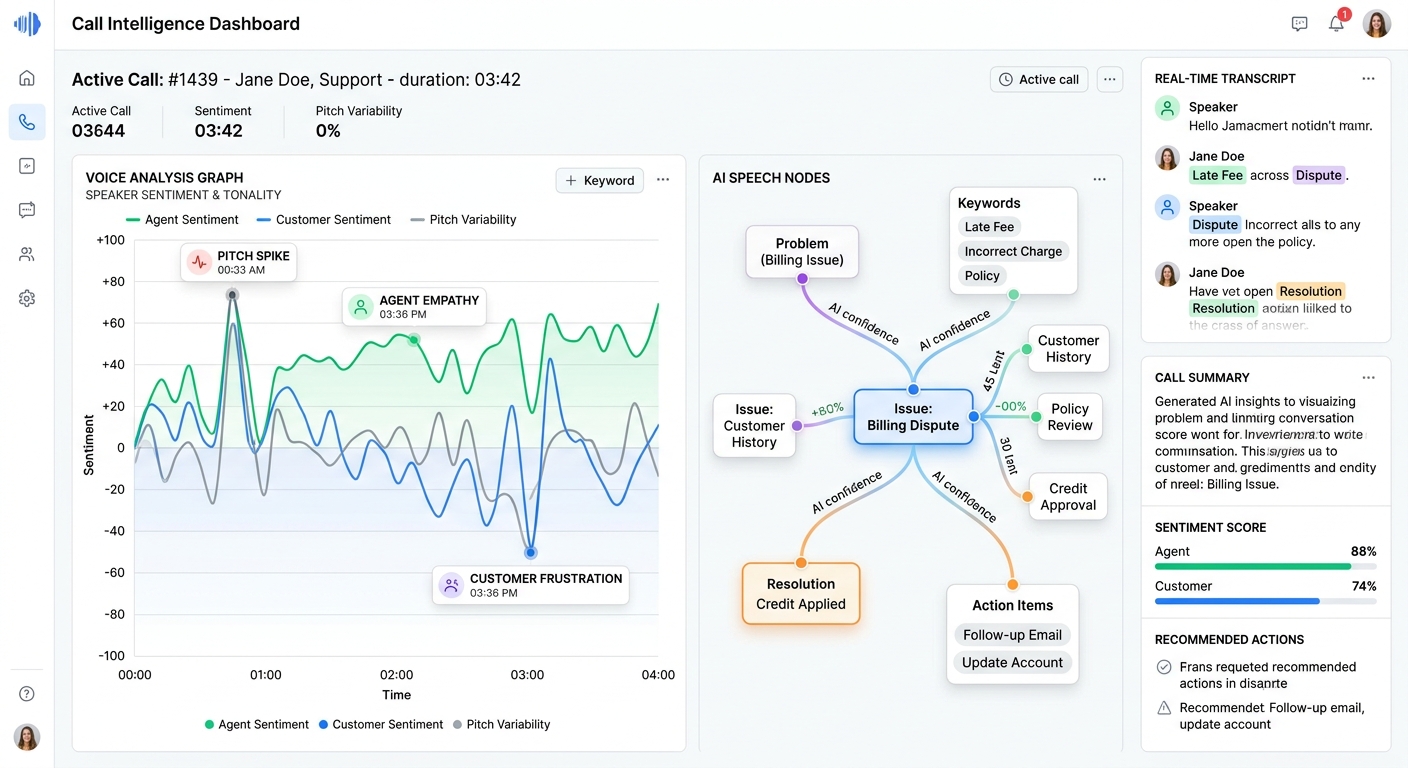
Analytics platform has been launched — a platform that transcribes every phone call, scores it against your company’s own quality criteria and turns the results into agent KPIs and coaching. It connects to 3CX, Asterisk, XCALLY, Genesys Cloud, Avaya and Cisco phone systems and works with Lithuanian, Latvian and English calls.
Audible has developed a controllable text-to-speech pipeline that uses LLMs to profile characters and attribute dialogue with up to 97% accuracy. By providing 'stage directions' as natural-language captions, the system ensures distinct, consistent character voices over long-form content.
AWS has upgraded the Amazon Polly Generative engine with more natural, expressive speech and better accuracy for numbers, addresses and confirmation codes. The update adds 14 new voices across 9 locales, bringing the total to 57 generative voices in 11 languages and 25 locales, including first-time general availability for Hindi and Finnish. It is a drop-in upgrade: voice names, APIs and pricing stay the same, so existing applications work unchanged.
IBM rolled out three updates to its Granite Speech family: a brand-new 2B speech-language model (granite-speech-5.0-2b), a revised 470M Turbo CTC model built for speed, and an improved 4.1-2B-Plus model tuned for multi-speaker recordings. Together they target high-accuracy transcription/translation, fast on-device recognition, and accurate speaker/timestamp labeling. All three remain under Apache 2.0.
Mistral AI released Voxtral 3, a set of speech recognition and speech synthesis models paired with an SDK that lets a single real-time pipeline listen, reason, call tools and speak back. The recognition models (Small, Mini and Realtime Transcribe 3) cover 50+ languages with speaker diarization, keyword-biasing for technical vocabulary, and transcription latency under 500ms, which Mistral claims beats Whisper, Scribe v2 and Gemini 3.5 Transcribe on its benchmarks. The speech synthesis model, Mini TTS 3, handles 35+ languages and 50+ dialects with emotion, pacing and emphasis that adapt to context, priced at $13 per million characters, and a separate Pro Voice feature can reproduce a person's voice and emotional range from just 30 minutes of recorded audio. All components can run through Mistral's EU-hosted API or be deployed on a customer's own servers.
AWS and Deepgram jointly rebuilt the Nova-3 speech-to-text model to run natively on Trainium2 chips instead of standard GPU-based PyTorch setups, targeting large offline transcription jobs. The work involved rewriting bottleneck layers as custom kernels and replacing Deepgram's Python serving layer with a Rust runtime calling Trainium directly. The result: a single trn2.3xlarge instance running eight parallel model copies delivers 11-70% more transcribed audio per dollar than Deepgram's prior infrastructure, with similar savings potentially available to customers self-hosting on SageMaker.