Anthropic launched Claude Frontier Academy, a $100 million program to train 10,000 engineers as 'Frontier Deployed Engineers' (FDEs) by the end of 2027. The first cohorts, running in San Francisco, New York and London, include engineers from Accenture, Bain, Capgemini, Commonwealth Bank of Australia, Deloitte, McKinsey, Morgan Stanley and Novo Nordisk. The program follows a medical-residency-style model: a multi-day in-person training followed by a 12-week residency leading a real Claude deployment at their own organization, with assessments and badges along the way.
AWS published a walkthrough for connecting Claude Desktop (running on Amazon Bedrock) to a managed, MCP-compatible Web Search tool through Amazon Bedrock AgentCore Gateway. The integration uses AWS IAM Identity Center for SSO, federated through Amazon Cognito, with JWT-based authentication securing all traffic to the gateway. Web Search is backed by an Amazon web index spanning tens of billions of documents, keeping all query traffic inside AWS infrastructure with no external API keys required. It is currently available in three AWS Regions: us-east-1, eu-west-1, and ap-northeast-1.
NVIDIA released a detailed workflow for fine-tuning its Nemotron 3.5 ASR multilingual streaming model on Saudi Arabic dialects (Najdi and Hijazi). Using minimal data curation, replay mixing with FLEURS data, duration-based bucketing, and partial encoder unfreezing, they reduced word error rate on the target dialects from 55.05% to 29.96% while also slightly improving English and other Arabic performance. The post also covers decoding tweaks and speaker diarization extensions for multi-speaker transcription.
Google Cloud introduced, in public preview, a remote MCP server that exposes the gcloud and bq command-line tools to AI agents via two tools: run_gcloud_command and run_bq_command. The server runs in an isolated, network-restricted sandbox on Google Cloud infrastructure, removing the need for agents to install or maintain local CLI binaries. It uses Agent Identity, OAuth 2.0, and IAM for authentication, integrates with Model Armor to screen for prompt injection, and supports Cloud Audit Logging for full visibility into tool calls.
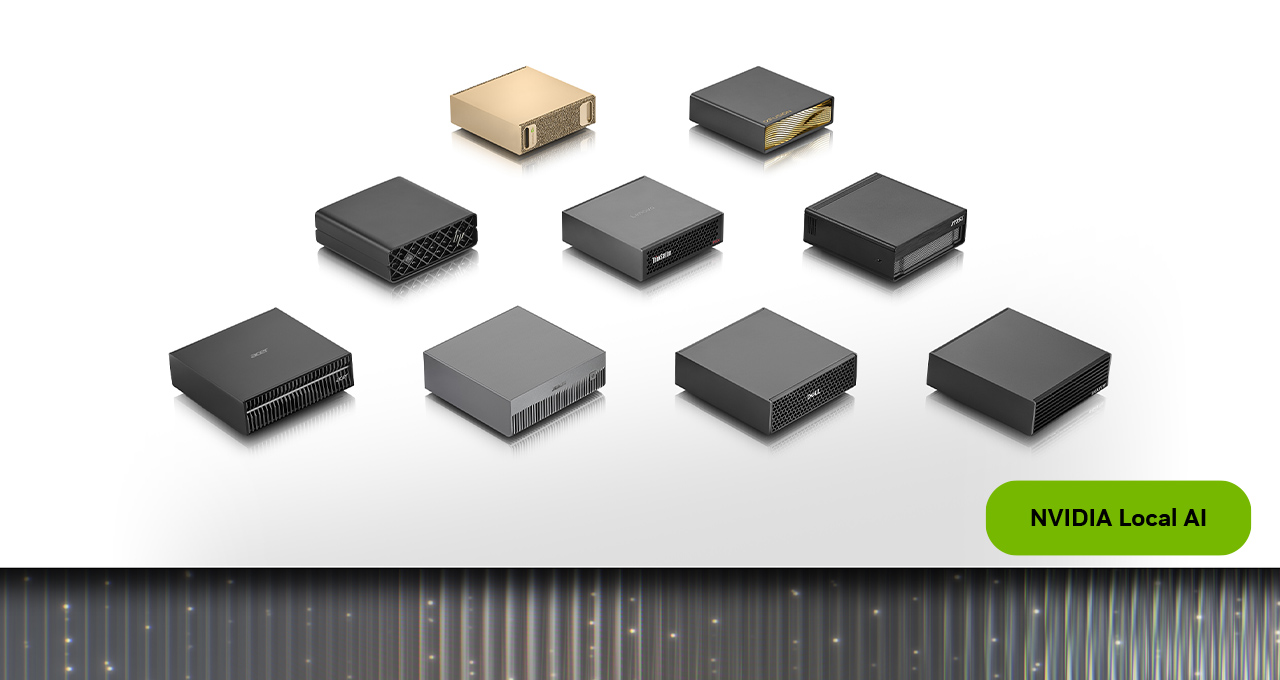
NVIDIA is releasing a new 64GB unified memory configuration of its DGX Spark personal AI supercomputer, available from partners like Acer, ASUS, Dell, HP, Gigabyte and MSI starting Oct. 23 at $4,999. The system runs up to 100-billion-parameter models locally on device, and two units can be clustered via NVIDIA Sync Cluster Assistant to pool memory to 128GB and support models up to 200 billion parameters, with up to 1.7x performance gains in NVIDIA's Qwen 3.8 27B test. It ships with the NVIDIA Agent Toolkit, CUDA-X AI libraries, Nemotron models and support for Ollama, vLLM and PyTorch out of the box.
Google announced that its Antigravity SDK now supports running agentic workflows locally and offline, with initial support for Gemma 4 26B A4B running via Google AI Edge's LiteRT. Developers can build agents that run entirely on-device, without cloud API costs or internet dependency. Google also demonstrated a hybrid 'Architect-Builder' pattern where a cloud model (Gemini 3.8 Flash) plans tasks and a local swarm of Gemma 4 26B instances does the heavy execution, keeping source code off the cloud.
Google Cloud API Gateway now supports acting as a remote MCP server in Public Preview. By annotating an existing OpenAPI spec (x-google-api-management.mcp and x-google-mcp-tool), teams can expose their current REST operations as agent-ready MCP tools without building or hosting a separate MCP server. Existing authentication (JWT/API key), quotas, and logging continue to apply unchanged since MCP and REST traffic share one policy path.